
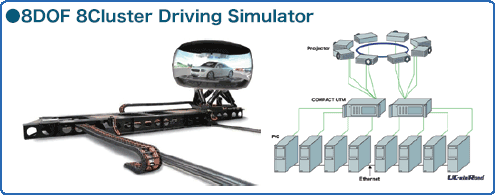
UC-win/Road Cluster option allows more than 4 channel display per PC.
It can project images to multiple monitors by synchronizing multiple PCs.
UC-win/Road
Cluster Plugin Option
Initial Release:2012.04.12
- UC-win/Road
Cluster Plugin Option - USD8,600
- UC-win/Road
Cluster Client Version - USD600
Related Product: UC-win/Road
Program Overview
UC-win/Road Cluster option allows more than 4 channel display per PC and can synchronize multiple PCs and project images to multiple monitors.
The system will be ideal for simulators and conference rooms with 360-degrees cylindrical screen, and control room simulations.
| ■ Easy operation : Easy set up and operation ■ Flexible system : No limitations to the number and configuration of clustered PCs ■ All functions of UC-win/Road : All functions of UC-win/Road can be used on clustered configurations. ■ Improved performance : Improved performance on clustered system compared with single PC system ■ Multipurpose system : A variety of simulations are possible in this multipurpose system which has all elements synchronized. |
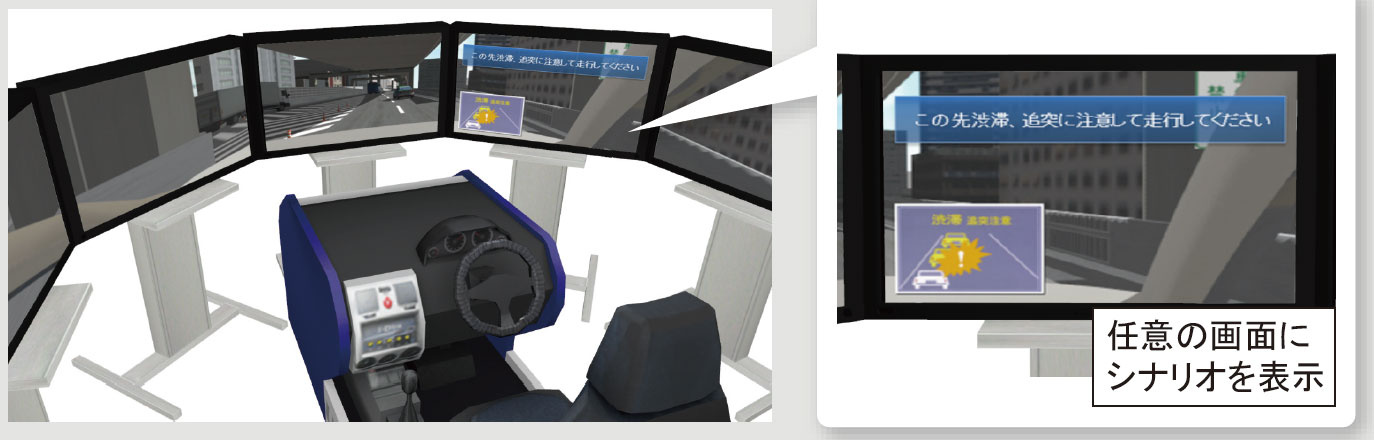
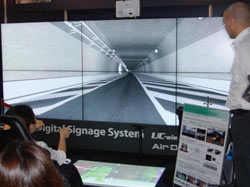
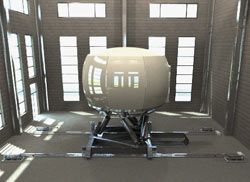
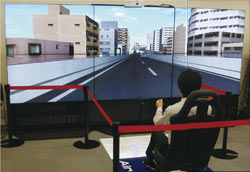
▲ Six-screen digital signage
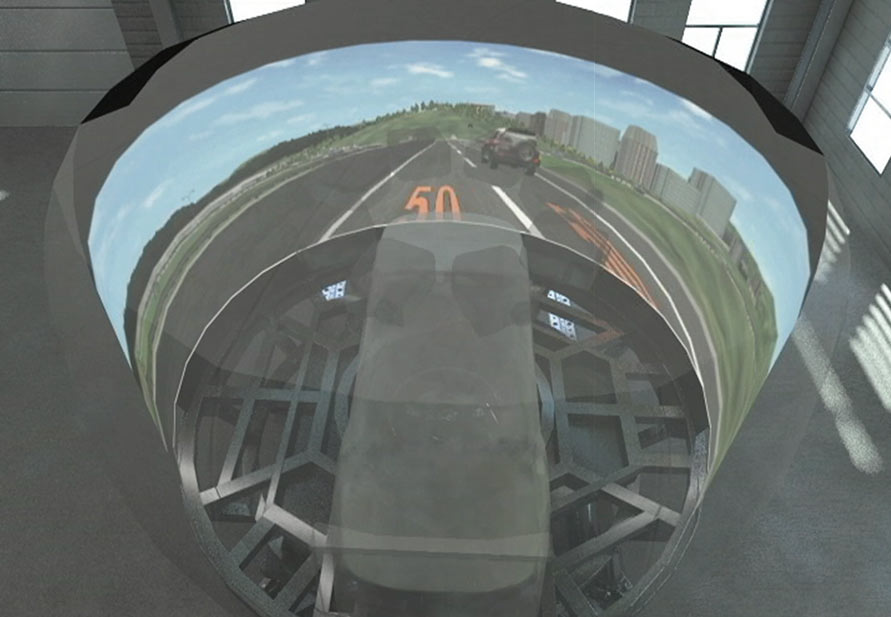
▲ Dome type drive simulator
Functions and Features
Implementing clustered system
-
- Simulation is calculated once for each frame.
- After each calculation, the data required is sent to the slave machines.
- While the slave machines process these images, the server calculates more data for the next frame.
- The server will send the data for the next one frame, if the calculation takes less time than the time it takes for the slave machines to process the image.
This optimization minimizes problems caused by data sending/receiving time. Multicast IP is utilized to send data to the slave machines, so that it minimizes the work load at the server and on the network. - After image processing finishes, the server will perform the next calculation and data transmission.
Multiple PCs are connected via LAN, and one PC calculates the simulation. The calculation results are sent to the other PCs, which then process the images to display. In this system, the machine that calculates the simulation is called "the server" and the machines that receive the calculation results and process the images are called "slave machines". The calculation and processing of images are performed as follows.
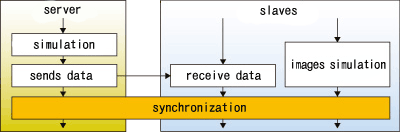
▲Data flow by frame
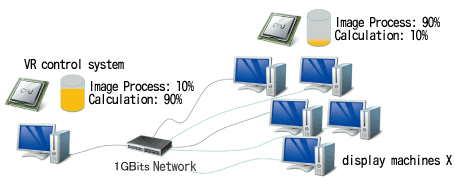
In the cluster system, one server machine calculates the simulation and the slave machines are used solely to process images. Because of the distributed workload, the performance of the system is improved.
The previous versions of UC-win/Road processed all the calculations except for the traffic in a single thread, but for this multiple display channel function, the calculation and the processing had to be performed independently. As a result of optimized use of multi CPU and multi-core CPU on the standard configuration of the UC-win/Road, we can see the improved performance of 3D trees, flags, clothes, fire and smoke and the animation of MD3 characters.
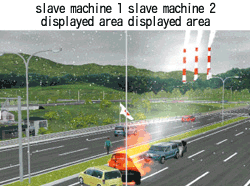
▲Synchronization of flags, fire and
smoke, vehicles and snow
The data, which server sends to the slave machines, are the information and attributes of moving elements. Each slave machine processes images after receiving data to update the 3D space. When visualizing 3D trees, flags, rain and snow, the processing becomes more complicated, thus, the data becomes larger, and therefore, high speed data transmission over a network becomes nearly impossible. Hence, to process of these objects, server sends minimum parameters for the calculation and the slave machines processes the calculation.
Functions
-
As the functions for the cluster system was added with the standard version of UC-win/Road as the basis, the system has all the features of the standard UC-win/Road. To minimize operations on the slave machines, all the operations except for the initial settings can be done on the server machine. At the time of simulation, operation is done by server machine and visualization is done by slave machines.
The cluster system is operable only when using the following functions with following settings.
Initial setting of slaves Slave machine name, network address of server Server Area displayed by slave machines Disconnect slave machines Restart, shut down and data import of slave machines Switching to server/ standard mode or automatic start of server mode Simulation start/end
Performance benchmark
-
We measured the level of performance to check the validity of this system. We found that its performance improved, in comparison with the standard UC-win/Road system, and that the number of clustered PC does not affect the performance. In addition, by comparing 4-channel clustered configuration with the standard configuration, we saw the improvement of 140%. By comparing 15 slave machines and standard 1 channel, we saw the improvement of 20%.
Price
Product Price
-
Click here for the price of UC-win/Road
■Product Price
Product
Product Configuration
Price
UC-win/Road Cluster Plugin Option Plugin Option only USD8,600 UC-win/Road Cluster Client Version This system is a system that can
synchronize two or more PC and output
the image to a lot of monitors.USD600 ■Price of Floating License
Paying 40% of the product price allows anyone to use the product on any PC anywhere in the world.
Product
Price
UC-win/Road Cluster Plugin Option USD3,440 UC-win/Road Cluster Client Version USD240 ■Sample Configuration
Parallel clustering VR system which can work on server PC + slave PC and LAN environment
Basic option price Basic option price : USD8,600
(Supports 3 slave PCs and 1 server PC configuration)
<Basic option price>
・5 slaves : USD10,000
・10 slaves : USD16,000
・16 slaves : USD20,000
UC-win/Road license is necessary on server PC.
Cluster Client version (USD600) is necessary for each slave PC.Maintenance and support cost Maintenance and support cost as per FORUM8 price policy.
Installation fee is required at an additional cost.Sample configuration If UC-win/Road 3D stereo display function is used, 1PC can display 2 channels, therefore,
for 16 channel display via cluster system, 8PCs and 1 server PC are required.
Price of Subscription Service Contract
Price of Subscription Service Contract
-
■Support information
-Software upgrade -Technical inquiry (Email, Tel)
-Download service -Maintenance and update notifications via email
* We are sequentially making a transition from the maintenance-support service to [Subscription Service] from April 1, 2016 in order to enhance support for diverse product usage and to reduce license management cost.
Product Subscription cost
of first yearSubscription cost
of subsequent years
(annual cost)Subscription (UC-win/Road Cluster Plugin Option) Free USD3,440 Subscription (UC-win/Road Cluster Plugin Option Floating) USD3,612
Price of Rental License / Floating License
■Rental license : Short term licenses available at a low price
■Rental floating license : After web activation, anyone can use the products on any PC anywhere in the world.
■Rental access : You can increase the number of licenses you own and use these additional licenses for a specific period of time (1 month to 3 month) at your discretion. We will later send you an invoice based on your usage log. The advance application is 15% off of the regular rental license price. Please place an order from User information page.
*Rental / Floating Licenses were introduced on September 2007 to enhance user experience and convenience of our products.
*Duration of Rental / Floating Licenses cannot be changed after starting these services. Re-application is required to extend the rental and floating license duration.
Rental license / Rental floating license
-
■Rental License
Product 2 month 3 month 6 month UC-win/Road Cluster Plugin Option USD3,870 USD4,558 USD5,590 UC-win/Road Cluster Client Version USD306 USD360 USD444 ■Rental Floating License
Product 2 month 3 month 6 month UC-win/Road Cluster Plugin Option USD6,450 USD7,654 USD9,460 UC-win/Road Cluster Client Version USD516 USD612 USD756 Order / Contact Us
Order / Contact Us
-
Inquiries about UC-win/Road: road@forum8.co.jp
Order
Contact us from Sales inquiry or email to ist@forum8.co.jp


LOADING